Ways to Endure, Final Chapter
“My love, I was so wrong…. When I left my body, I did not go away…. I am more with you than I ever could have imagined.” –Andrea Gibson, “Love Letter from the Afterlife” [1]
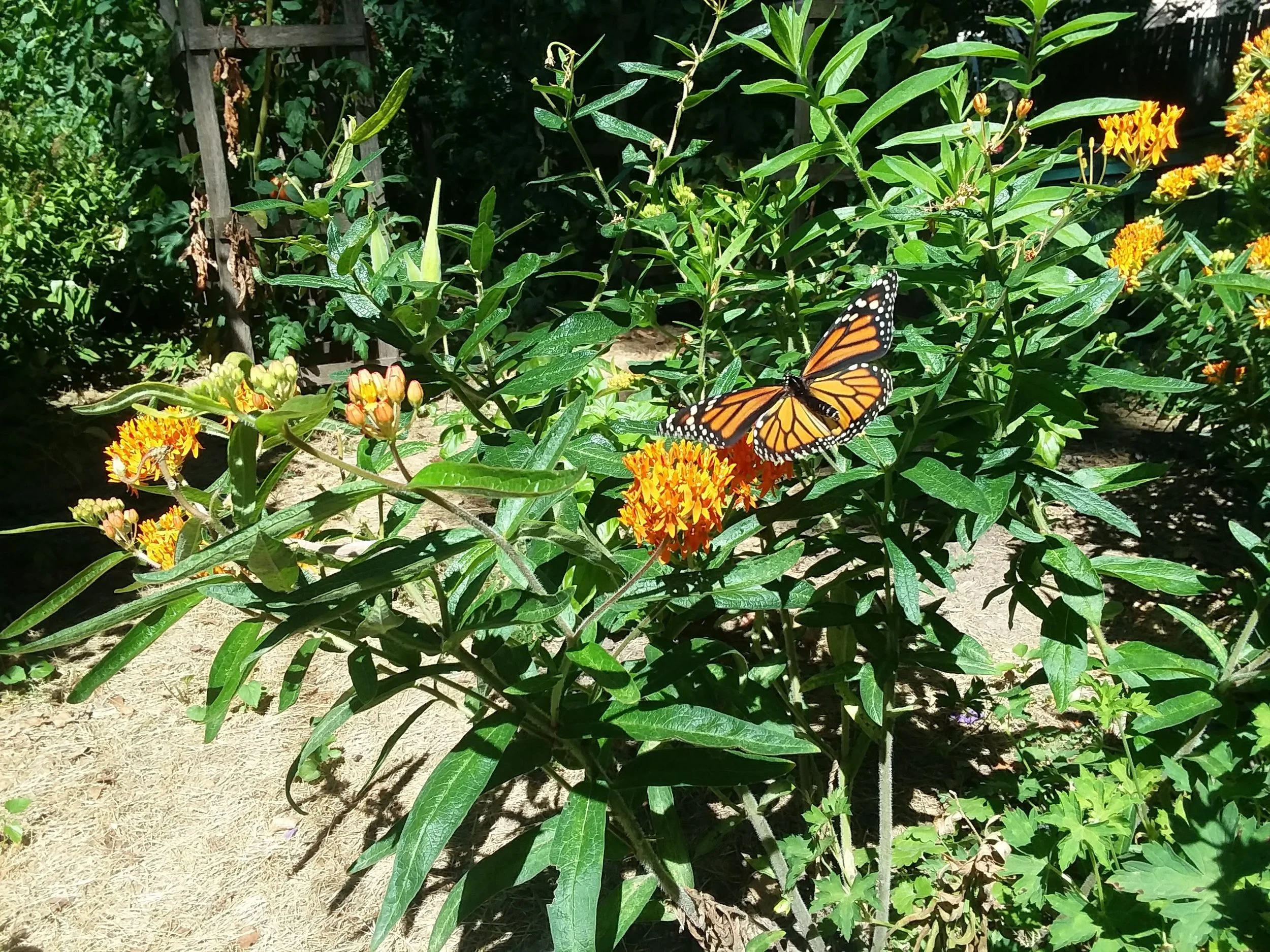
Monarch on Pat’s butterfly weed, August 2018
This is the ninth in a series I began over two years ago. For much of my wife’s nearly decade-long wrestling match with her mortality, we lived in the moment. Everything outside of that felt like a blur. Writing about that time has given me access to something approaching clarity and perspective. After the eighth chapter, I stepped away to write a series of pieces that celebrated the woman I met fifty years ago and memorialized the early years of our marriage. It’s taken me almost ten months to return to this story. I guess part of me doesn’t want it to end.
In September 2016, as the Mayo Clinic doctors were weighing options for Pat’s next cardiothoracic surgery, a radiologist studying her CT scan noticed shadows on her bladder, and one on her lung, a sign of tumors. The urologists agreed the safest (although not the most effective) method to address the bladder tumors would be to remove them using an instrument inserted through the urethra. The procedure took little more than an hour, barely long enough for me to read and comment on four student essays. We were told to go home and await the biopsy results.
Having been focused on the aortic graft infection and the ticking time bombs of aneurysms, we felt blindsided by the likelihood of a cancer diagnosis. I was ready to provide whatever support Pat needed, but I waited for her lead. We drove south on way-too-familiar U.S. Highway 63, lost in our thoughts, past farmers harvesting corn and soybeans. At last, she turned to me, “David, I don’t want to fight this anymore.”
We returned to our lives, made joyfully rambunctious by the presence of our daughter Emma and our grandsons, three-year-old Oscar and nine-month-old Linus, who stayed with us the next three months. Being with the boys helped remind us to live in the moment. Emma was a tremendous help, easing my concerns about how Pat was doing while I was thirty miles away. I could avoid dwelling on what lay ahead and focus instead on the needs of my students. We distracted ourselves with the string of end-of-year holidays: Halloween, Thanksgiving, Christmas, New Year’s Day. But cancer doesn’t take holidays. It continued to spread as it often does in its early stage – stealthily but steadily.
Pat and I returned to Rochester three times in late January and early February for appointments with Dr. Fernando Quevedo in the Department of Oncology. After the last visit, he sent a letter to Dr. Yousef Zakharia at the University of Iowa Hospitals and Clinics (UIHC) that, in part, stated:
We together reviewed the CT of the chest, and unfortunately, the prior pulmonary lesions are increasing in size, and there are now many more new bilateral pulmonary lesions, all of this more consistent with metastasis disease than an infection process. Ms. Duer is a nurse. She took this amazingly well. She is brave. She knows she has different competing causes for death, including ongoing infection, heart disease, and now cancer. She is in a difficult situation. She is not a good candidate for chemotherapy or immunotherapy but wants to receive symptom control and keep quality of life.
A week later, at a follow-up appointment with Dr. Zakharia, he reviewed the new scans and offered his prognosis: Three months to live. We looked at each other. Okay, deep breaths, three more months it is. The next day, we contacted Iowa City Hospice, and by the end of the week, we’d met with them and begun receiving care that would make her as comfortable as possible while easing the escalating effects of the cancer.
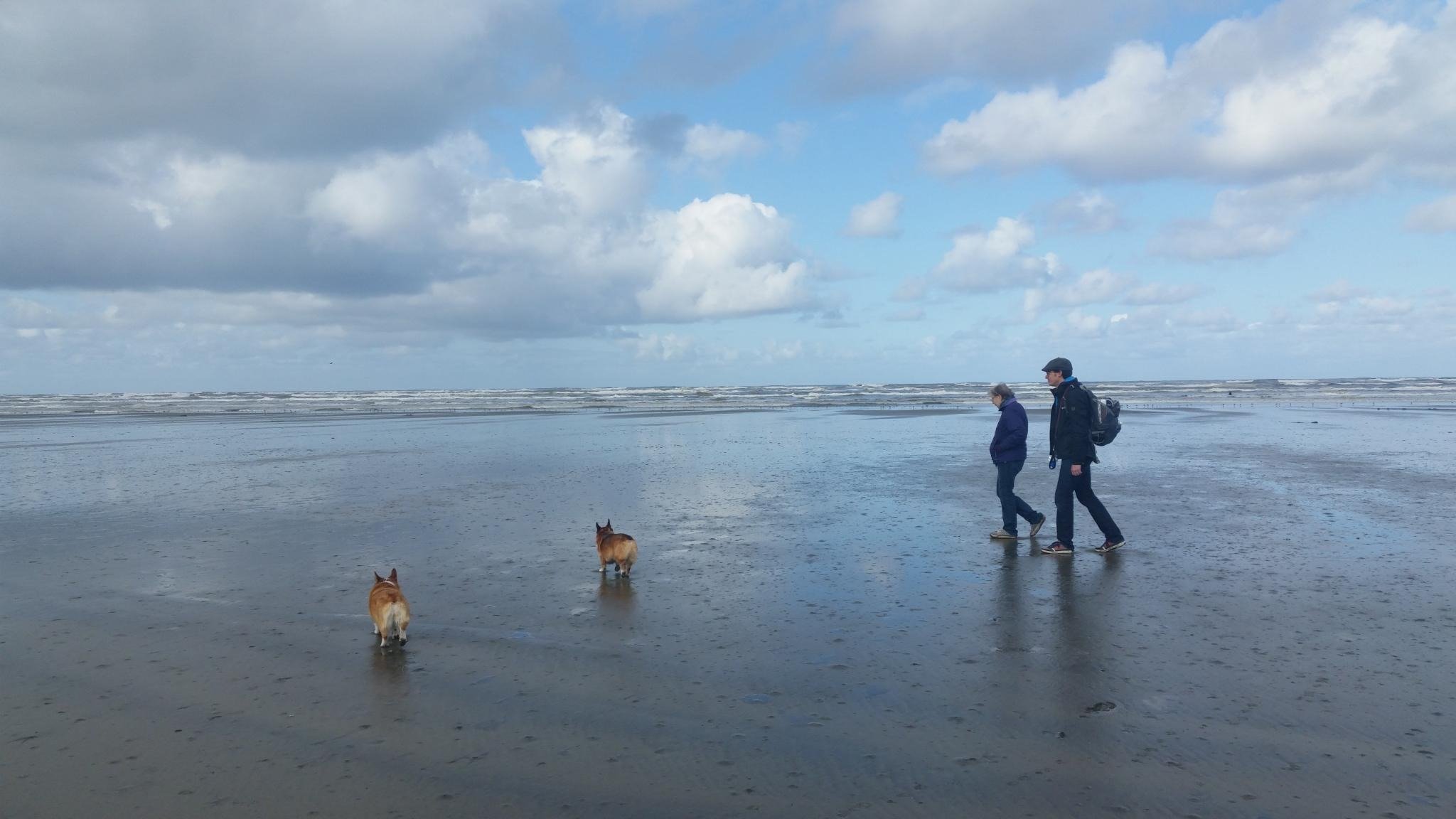
Pat, Sierra, Miso, and Ollie at Copalis Beach, April 2017
In late April, Sierra and Tina flew Pat out to Seattle so they could spend time together. She embraced the simple pleasure of hanging out with her oldest son, his wife, and their corgis, Miso and Ollie. They rented a beach house on the edge of the Olympic Peninsula rainforest, taking long walks at low tide, wandering from tidepool to tidepool, watching waves roll in as the sun set on the Pacific. The ocean always had a calming effect on Pat – she’d get those faraway eyes as her worry lines dissolved.
Not long after Pat got home, Emma, Oscar, and Linus returned from Virginia to be with her. Emma made the 800-mile drive in one long day, made longer by the fact that Linus hated being strapped into a car seat and made his displeasure known in the only way a baby can.
Sharing our house with them was a delightful distraction. While Emma spent time with Pat, I spent time with Oscar and Linus. Oscar was a fan of the Thomas & Friends TV series, and our carpeted basement floor was taken over by an ever-expanding set of wooden railcars and train tracks, which we reconfigured daily with the aid of bridges, trestles, and tunnels. As far as I was concerned, it was as close to a win-win as we were going to get. I’ve always felt the presence of our daughter and grandsons kept Pat too busy to think about dying. Every day she had three more good reasons to get up in the morning.
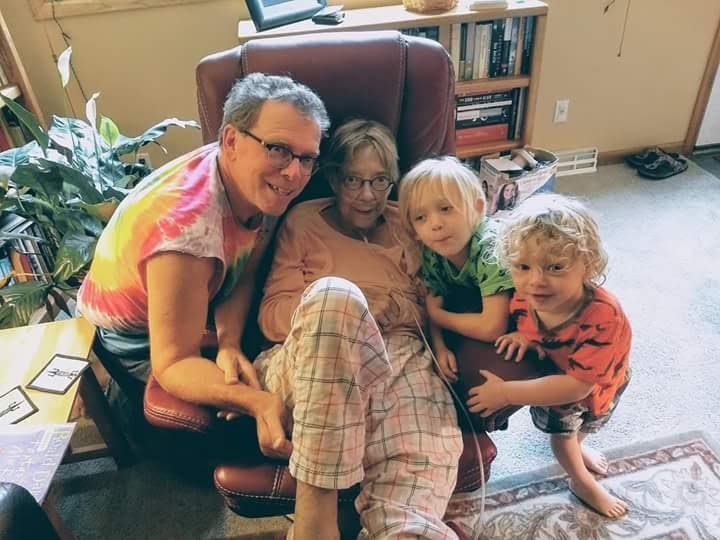
Linus, Oscar, Pat, and me, July 2018
Iowa City Hospice was also a daily presence in our lives. Pat had the highest praise for the nursing staff who stopped in to check on her. This was not a given – as a former nurse and director of nursing at a skilled care facility, she knew when she was and wasn’t getting good care. Bedside conversations between Pat and the hospice nurse, Denise Bickford, might begin with matters of physical health but often ranged far beyond that. She was able to prepare Pat to face the end of her life far better than I ever could have.
Later that spring, after suffering some minor falls, Pat began to use a front-wheeled walker to help her get around. Coupled with that, she was increasingly dependent on the bulky oxygen concentrator that chugged away in our spare bedroom, the oxygen tubing becoming her 25-foot tether. A portable concentrator with a car adaptor allowed her to go out for short excursions or drive downtown for her weekly counseling sessions.
But her mobility issues worsened over time, and those excursions became increasingly complicated. When I was with her, I tried to assist in a way that made it look as effortless and efficient as possible. In my mind, the easier it all looked, the less Pat would feel she was putting anyone out, and the more comfortable she’d be about going out. Perhaps, this is the point in the story when I acknowledge the UIHC oncologists’ prognosis of three months to live would be off by seventeen months.
When we had a Fourth of July picnic in City Park, I was reminded that one of the perks of being a grandparent, or parent for that matter, was getting to do all sorts of silly stuff without anyone questioning my sanity, such as riding the Children’s Train one last time before it shut down the following year. Oscar enjoyed the pokey little train ride, while Linus and I shared a cramped car and went bonkers, hollering and waving at every person we passed.
In August, Emma decided she and the kids needed to get back to their life in Virginia. Meanwhile, school was about to start back up for me. I wanted to hire some home health care for Pat, but she didn’t want to spend the money, and didn’t think she needed that level of attention: “The only company I need is Auggie.”[2] But she continued to have falls. We reached a compromise that Pat grudgingly acceded to – we’d hire a company to send an aide for two hours three mornings a week. Pat disliked most of the aides, who often just sat around and scrolled through their phones. When Pat did make a positive connection with one, we’d ask the company to send them again, but that rarely happened. Over the course of the next year, we went through three different home health care companies.
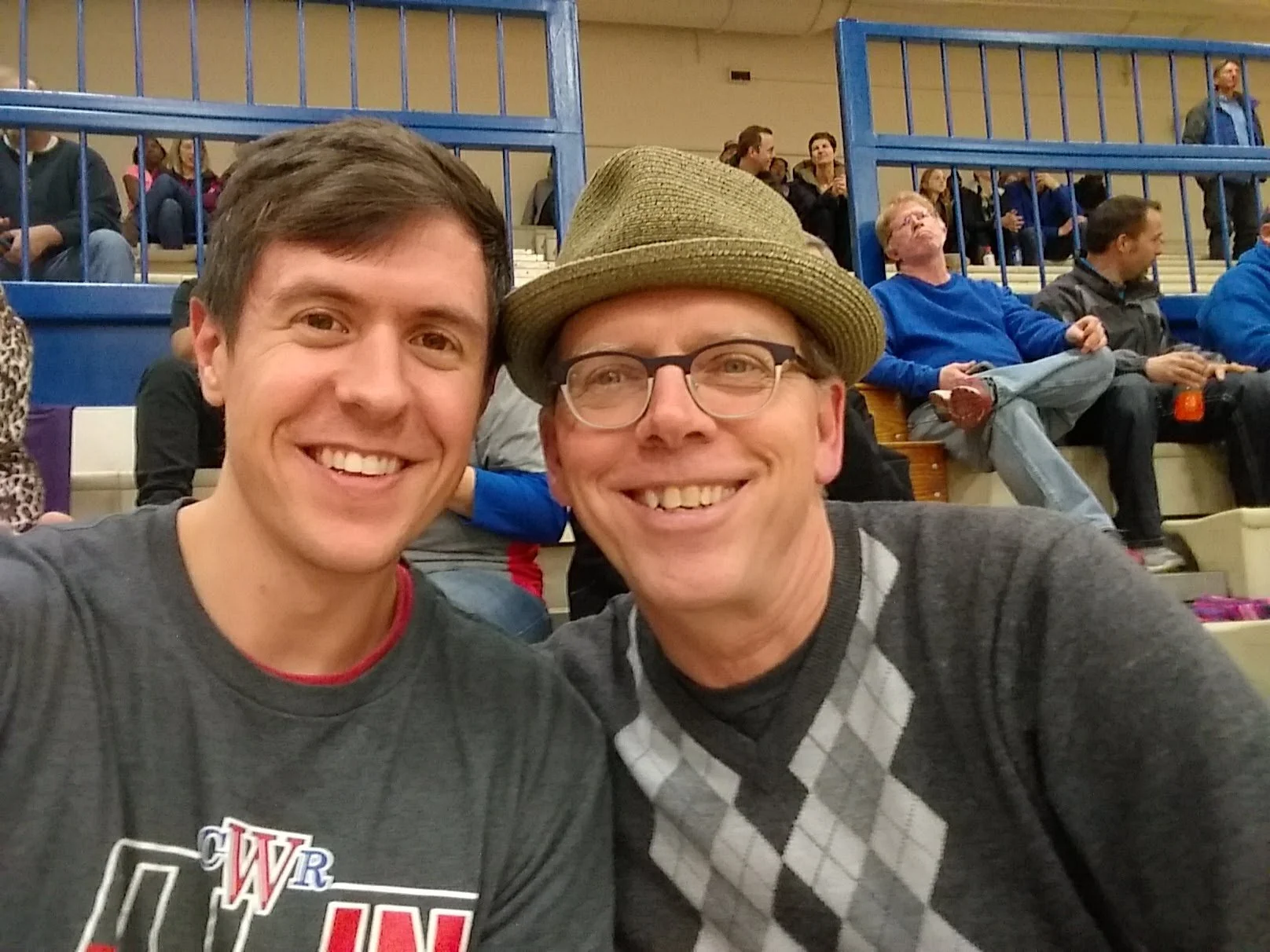
Tyler and me at a Washington HS basketball game, December 2017
That fall, I worked with the most memorable of the half dozen student teachers I mentored during my time as a teacher. Tyler James and I hit it off right away. That he was a hip-hop singer-songwriter, performing as Jim Swim,[3] added a feature that made him especially appealing to students. We discussed how best to fit our creative outputs into the square box of the classroom, and how to light a fire that could engage the most disaffected students. As always happened when I talked with student teachers about the choices one makes in the classroom, I became newly excited about the craft of teaching and the content of my courses.
Emma and the boys visited us at Thanksgiving, Pat’s favorite holiday because of its singular focus on family, friends, and good food. Our gathering wasn’t as big as it had been in recent years, but Pat and Emma worked together to prepare a turkey stuffed with a dressing from a recipe handed down from our friend Joan’s grandmother. My sister Julie and her family joined us, and she brought another family favorite, mouth-watering oatmeal roll from a recipe our friend Helen had shared with us.
Pat’s mobility problems continued to escalate. She was unable to flex her right ankle, and felt constant pain when she tried to put weight on that foot. She finally got x-rays, but no evidence of fractures or dislocations could be found. The spasming of her right foot muscles continued to contort her foot until it refused to rest flat on the floor, until she could no longer walk on it. She became dependent on the wheelchair she’d long resisted.
She hated sitting there waiting for it to get worse. In March, she began biweekly physical therapy sessions. Although she was never able to recover the strength and range of motion she had hoped for, she believed the PT kept her foot from deteriorating further, and continued the sessions until the last weeks of her life.
I had taken over the task of managing Pat’s meds, a stressful responsibility because although I couldn’t recall the exact effect of every pill, I was sure each one played a crucial role in maintaining her fragile equilibrium. On Sunday evenings, I’d fill the 21-compartment pill organizer for the week, check the oxycodone pill and fentanyl patch supplies, and call in any prescriptions that needed refilling. I would apply Pat’s fentanyl patch, locating a fleshy spot on her back where the patch wouldn’t be disturbed and blood flow would be optimal, keeping track of the date and time so we’d know when it should be replaced. I sometimes screwed up on calling in a prescription renewal or refill, but I was able to count on the hospice staff to bail me out.
Each morning, we’d look forward to what the day would bring. We felt renewed hope for our son Jesse, who with the support of his girlfriend Lilia, had just finished two months of rehab and was living in Austin. I hung a bird feeder on the bare limbs of the linden outside our bedroom’s north window so Pat could enjoy the black-capped chickadees and goldfinches feasting on black oil sunflower seeds.
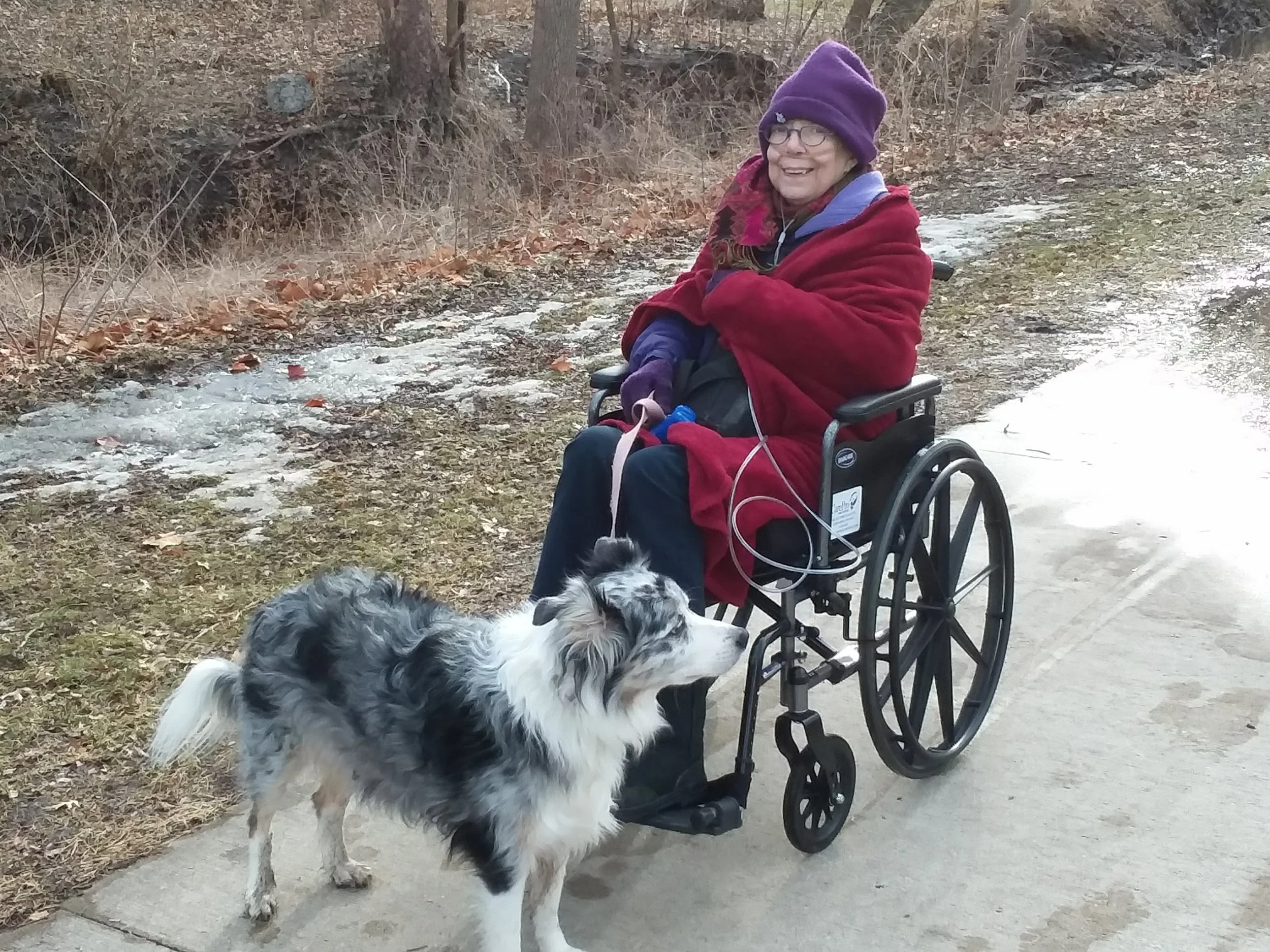
Pat and Auggie on a walk through Court Hill Park, February 2018
When I’d get home from school, I’d help Pat into her wheelchair so we could take Auggie to Court Hill Park. She never tired of watching Auggie run and leap high in the air as we played catch-and-fetch with his frisbee. After dinner and my class prep or grading, Pat would lie on the couch, her feet on my lap while I massaged them, and we’d watch the next episode of one of the gritty crime procedurals streaming at the time: Top of the Lake, Mindhunter, Broadchurch, Bosch. Those virtual brushes with evil and quests for justice felt cathartic to us.
In June, Iowa City Hospice staff asked to meet with us. Citing evidence Pat wasn’t progressing quickly enough toward her death, they explained they’d have to discontinue their care for her. It was an awkward conversation. We felt a rug had been pulled out from under us, but we understood – after all, they’d been providing Pat with end-of-life care for sixteen months by that point.
Those last few months felt like an inexorable march toward an indefinite end. Faced with the slow erosion of our spirit, we nonetheless stayed true to each other. We endured. Pat would occasionally play for me a Patty Griffin song, “When It Don’t Come Easy,” whose chorus was a reminder of our commitment to each other: “But if you break down/ I’ll drive out and find you/ If you forget my love/ I’ll try to remind you/ And stay by you/ When it don’t come easy.”
Pat made an appointment to see an OB-GYN doctor, Margaret Smollen, who prescribed a pessary, a device she could wear to support her prolapsed uterus – one more way in which her body was breaking down. Because of her history of UTIs, Pat had been self-catheterizing for years. In her increasingly weakened condition, she struggled to do what had been second nature to her. She began to ask me to insert the catheter. When I was occasionally successful, I would give a little celebratory whoop, but my success rate wasn’t great.
On October 28, a Sunday night, Pat called me into the bathroom. She was bleeding from her vagina at an alarming rate, and wasn’t able to get it under control. I said, “Sweetheart, we need to go to the ER.” At Mercy Hospital, we brought the nurse up to speed on Pat’s medical history and explained her vaginal bleeding. The doctor was able to staunch it, but said he wanted to keep her overnight for observation. The next day, she was moved to the hospital’s hospice ward.
By the time I got to her room after my classes, Pat had taken a turn, her face screwed up in pain. I tried talking with her, but she was distracted by the messages her body was sending her. At one point, she looked up and said, “I don’t understand – your thoughts got in my way.” I asked the nurse about her meds. It took a few minutes to discover the dosage of the fentanyl patch they’d applied was much lower than she’d been getting. By then, it seemed she reached some medical tipping point, although perhaps simply being hospitalized was the last straw.
Early in the evening of November 5, as Emma and I ate take-out tacos from El Bandito’s and chatted with our friends Ken and Helen and my sister Julie, Pat left this world. Seven years later, on the anniversary of her death, I’m writing these words. It’s a sunny day. I’ve been thinking about Pat as I bike around downtown, putting up posters for an upcoming NO KINGS Food Drive Rally,[4] as I dig up dahlia and canna lily bulbs, wiping off the dirt and packing them in peat moss for next spring, as I fill the bird feeders and listen to the wind chimes she gave me on my last birthday with her. I agree with the poet Andrea Gibson – Pat’s still in my life, more than I could’ve ever imagined.
Footnotes:
[1] Spoken word poet and activist Andrea Gibson was the author of seven volumes. Appointed poet laureate of Colorado in 2023, they died at the age of 49 of ovarian cancer on July 14, 2025. A documentary of their life, Come See Me in the Good Light, won a Festival Favorite Award at the 2025 Sundance Film Festival.
[2] Our Auggie, an Aussie Border Collie mix with a beautiful blue merle coat, was intelligent, aware of Pat’s illness, and attentive to her needs.
[3] I encourage you to check out at least one of his pieces, “King of Cups.”
[4] We were supporting local food pantries scrambling to help families not receiving their SNAP benefits during the shutdown, after Trump had decided to not use contingency funds earmarked for the program. We collected donations of non-perishable food items and personal hygiene products totaling over 2,100 pounds.