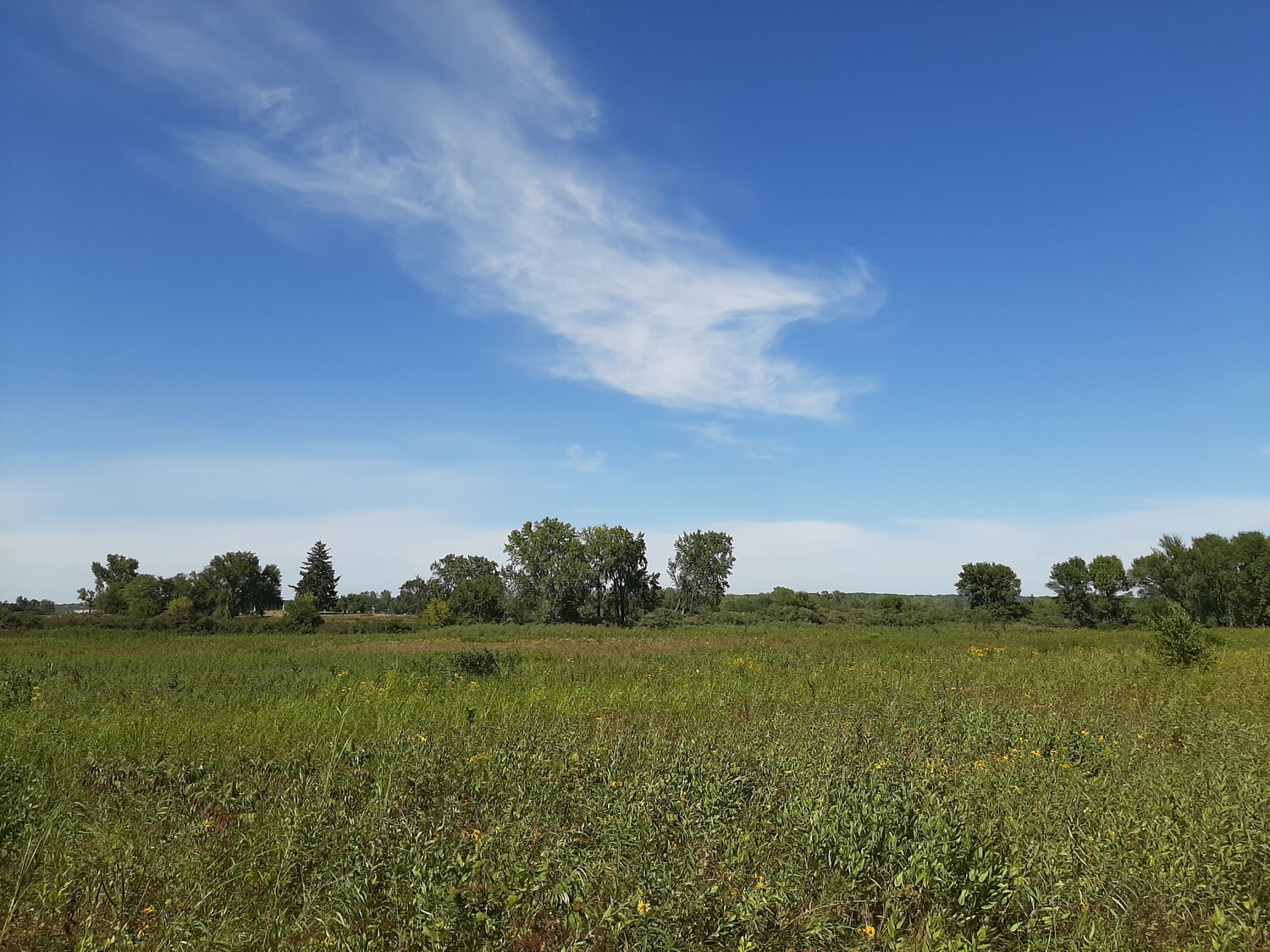
Moving to the Country
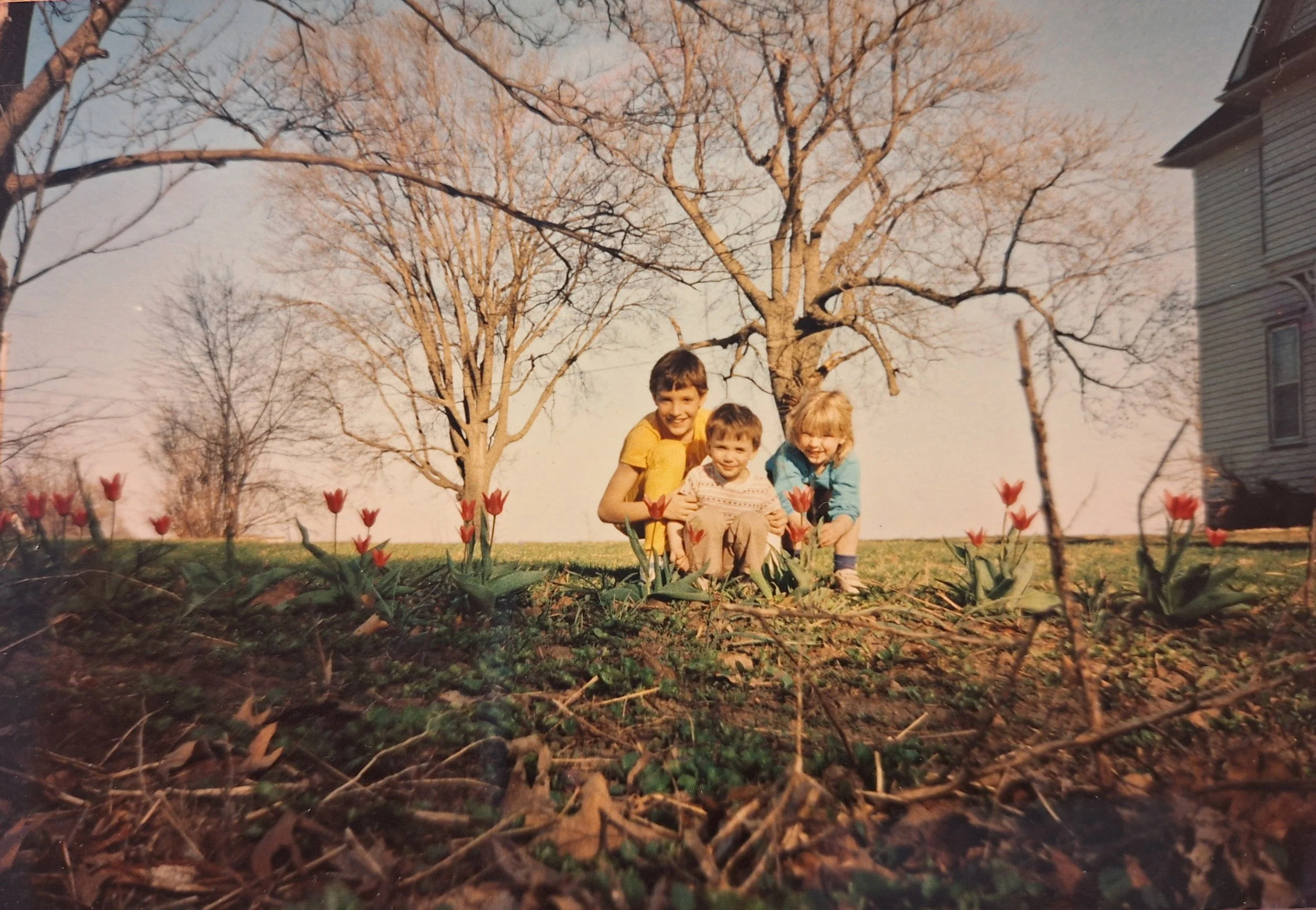
Sierra, Emma, Jesse, and tulips from the bulbs Pat planted our first fall in the country
“Out in the country, gravel road a-ramble all around.
And the dust blow up till the cool rain tumble down.” –Greg Brown, “Out in the Country”[1]
I sometimes wonder what our family’s life might have been like if I’d decided to stay in the world of letterpress printing and literary publishing, and move north to Minneapolis with Allan and Cinda Kornblum and their press. Instead, when we reached a fork in the road of our lives, our choice would eventually lead us to an old lovely house down a long gravel road.
By the end of 1983, Allan had squeezed the last bit out of the tube of Toothpaste Press. It was jokes like this that led him to rename his enterprise Coffee House Press, a name that sounded less flippant and required fewer explanations. In the summer of 1985, he undertook the next stage in the transformation needed to keep the press afloat. In Minneapolis, he hoped to benefit from the many foundations there that generously support the arts. Allan wanted me to stay on with the press, and some of the press’s publicity stated optimistically that I would be doing so. But my gross salary in my last full year at the press was $12,700, barely enough to support our family. Allan couldn’t promise me the kind of raise that would cover our moving expenses and the increased cost of living in a big city.
I was putting in extra hours in the final months before the press moved, applying the finishing touches to the last book printed in West Branch, packing up Toothpaste Press back stock and business files, trays of type, cans of ink and solvent, reams of paper stock, and all the other accoutrements of the press. I didn’t have time to look for new employment, but I also wasn’t confident I could conform to the expectations of a regular nine-to-five job, nor was I excited to do so. I procrastinated at the uncomfortable task of scouring the help-wanted ads, knocking on doors, applying for open positions. I was hoping to stay in the field of publishing, but few such jobs existed in the Iowa City area. I interviewed for copyeditor positions at the University of Iowa Press and American College Testing (ACT), but never got called back.
This went on for over three months. Up till then, Pat had mastered the art of getting us to the next paycheck. She had obtained multiple credit cards that we would sequentially max out and then slowly pay down the balance on. Pat had learned which creditors needed to be paid in full and which would accept a partial payment and which could be put off till next month. At first, these strategies troubled me. Although my parents occasionally bought furniture or appliances on the installment plan and had taken out a home mortgage loan through the GI Bill, the lesson I’d learned from my father was to avoid debt, a lesson he’d absorbed growing up in rural eastern Kentucky in the 1930s. When we got married, I didn’t own a credit card, and the only loan I’d ever taken out was one to cover my first year’s tuition at Iowa, which I paid off that May with earnings from my bakery job. Over time, I came to admire Pat’s knack for getting us through each month with a positive balance in our checking account.
But when I stopped bringing home a paycheck, our financial situation quickly turned precarious. If our Ford Escort didn’t need new tires, it needed new brakes. Every time it wouldn’t start, we faced a multiple-choice question: What now – starter, alternator, ignition switch, or battery? Our family was drifting down the river in a rowboat without paddles, and we could hear the falls up ahead. We had lifelines, but they were gossamer-thin. After Allan had settled into its new digs in Minneapolis, he began to send me manuscripts or page proofs to copyedit and proofread. I also found part-time editing work at Joan Liffring-Zug’s Penfield Press. And I began submitting poems to the arts page editor of The Daily Iowan, the UI student newspaper, and to my friend David Johnson, the editor of the weekly West Branch Times, who sometimes published them and paid me a small fee for doing so. But this income was neither steady nor substantial.
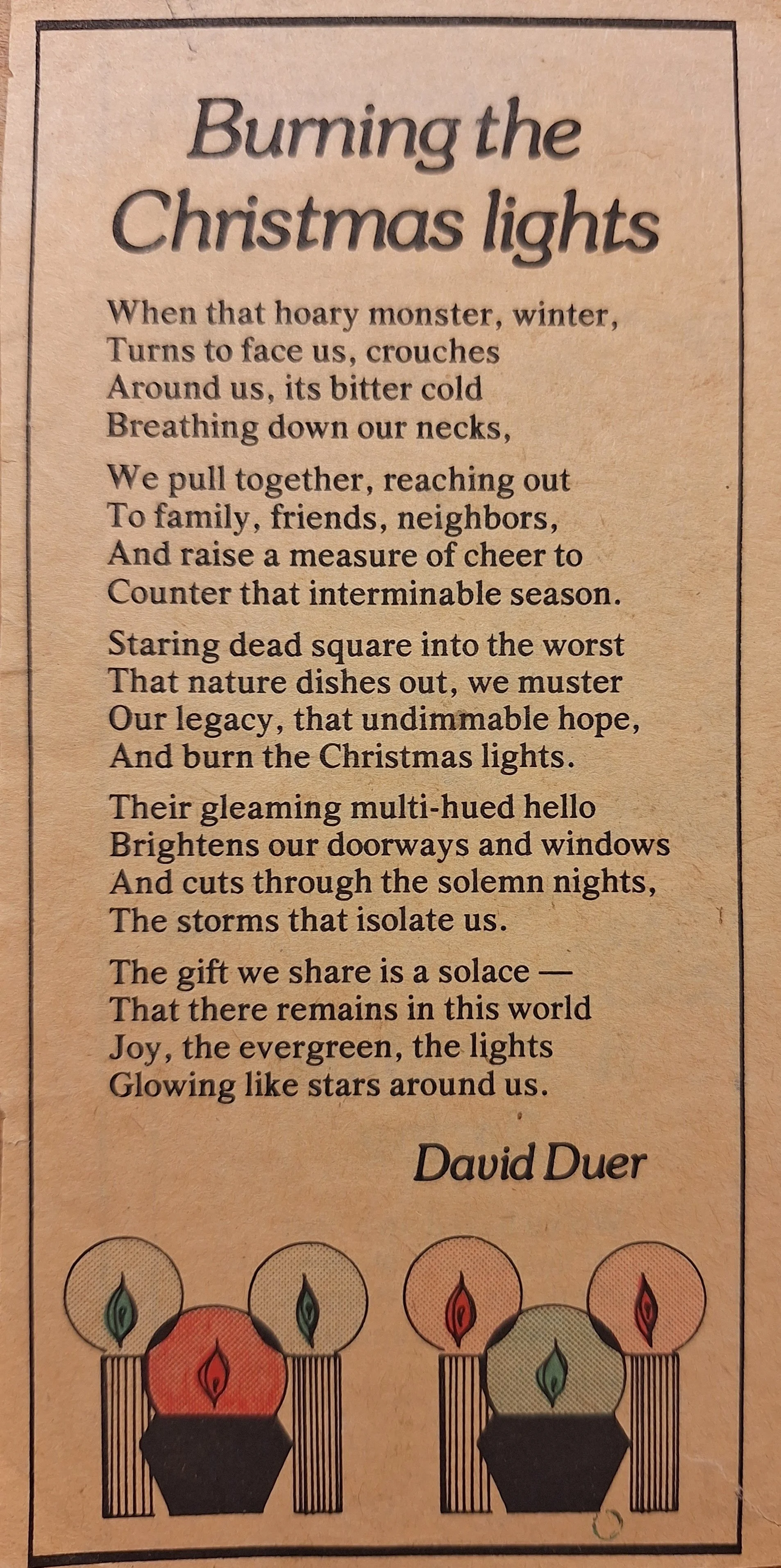
As published in the West Branch Times
After the first month without a paycheck, our family ventured to the Cedar County DHS office in Tipton to apply for food stamps. We suspected we’d need to show the social worker our children as proof of need. She coldly eyed us as we sat at her desk in a large drafty room, drilling us with questions whose answers would determine our worth. It seemed the social worker’s role was to mistrust us, and to make sure we paid for these benefits with our shame. Pat was seething. If I hadn’t been with her, she would’ve walked out on the interview. In the end, we were approved for food stamps and given a ten-pound bag of milk powder and five-pound block of cheese, byproducts of generous federal government subsidies awarded to dairy farmers, which had led to overproduction.[2] The pale orange cheese reminded us of Velveeta and tasted like humiliation.
By October, however, the trajectory of our family’s fortunes began to change course. I landed a Clerk II position at the UI Hospitals and Clinics, working the main registration desk. I became one of the faces of the largest hospital in Iowa, the person patients first encountered after walking through the front doors. Although the work could be mind-numbing, the graveyard shift was occasionally enlivened by drama. The vast hospital lobby would be empty and still until a couple came rushing in, frantically asking for directions to Labor & Delivery, their faces painted with a mixture of fear and excitement. I sometimes worked the ER registration desk. Weekend night shifts there could get wild. One had to be innovative when trying to get basic information – name, address, phone number, birthdate, insurance – from someone sporting a fresh head laceration from a bar fight and a blood alcohol content twice the legal limit.
I wasn’t bringing home as big a paycheck as I had in my last days at the press, but we again had income we could count on and, more importantly, for the first time, health insurance, a huge help for a family with three kids under the age of eight.[3] Six months later, I was promoted to a Clerk III position in hospital payroll, which guaranteed a regular nine-to-five shift, allowing me to join a university employee van pool so Pat could use our car. We could make out a glimmer of hope that this was the end of our worrisome years.
In 1985, our family of five was still living in the first-floor apartment of a house on North First Street. The kids shared a large bedroom, which was adequate at the time, but would soon be bursting at the seams. When my friend David Johnson mentioned that Ken and Helen Fawcett were looking for a family to rent a house on their farm property near Centerdale, three miles southeast of West Branch, our interest was piqued. After David spoke with them and vouched for us, Helen reached out to see if we’d like to take a look at the house.
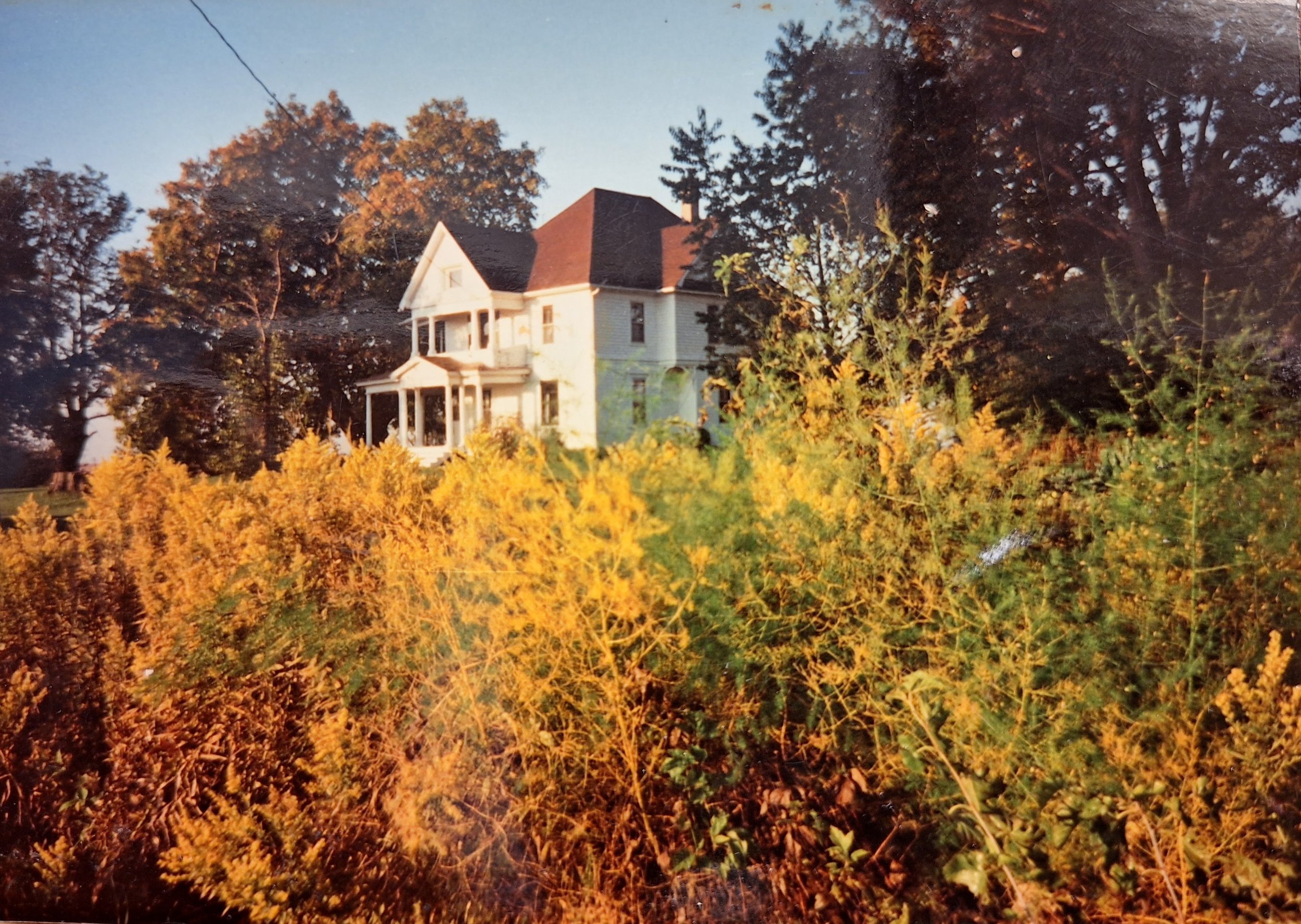
As we drove down the long gravel lane to the house, we immediately fell in love with it: a handsome American Foursquare with five bedrooms, a wraparound porch, and a screened-in porch off the master bedroom on the second floor. Its construction date was marked in the concrete slab at the end of the walk leading up to the porch: 1913. It had been in the Fawcett family all that time, and Ken and Helen were looking for a family who would not only live in but care for the house. Helen told us they were asking $350 monthly rent. I looked at Pat, but she was already picturing us living there. We exclaimed in unison, “We accept!”
Ken and his nephew Kent, assisted by his father Floyd and uncle Alfred, tended land that five generations of Fawcetts had been farming since 1851, earning a Century Farm designation. They were conservation pioneers, one of the first to use no-till farming practices in Iowa.[4] Growing up in the historic Amana Colonies, Helen was a talented gardener, cook, and craftsperson. Their children, Leanna and Thomas, were similar in age to ours. They lived a half mile east of us on the gravel road, which in the country was as good as being next-door neighbors. Drawn to their warmth and generosity, we found ourselves becoming close friends with our landlords.
We loved the house, a showpiece in its heyday, one of the 70,000 Sears and Roebuck kit homes built in the first decades of the 20th century. Shipped on the Chicago, Rock Island, and Pacific Railroad line that passed just a half mile away, the train would’ve stopped to unload the flatcars of house parts then hauled in hay wagons across a field to their present location, every floor beam and two-by-four numbered for easy assembly. We loved the three sliding wooden doors that divided the main downstairs rooms, oak paneling on the “everyday” side and finer-grained maple paneling on the “fancy” side. We loved the built-in china cabinet with a shelf whose back slid up so dishes of food could be passed from kitchen to dining room.
That first winter we learned the challenge of heating those high-ceilinged rooms. A stand of woods west of the house offered minimal protection from the wintry Alberta clippers that picked up speed as they swept unchecked across the prairie. We sealed off two front rooms and the front stairway. I weatherized every west- and north-facing window – nailing up clear plastic sheets framed with lathing strips – to minimize the cold drafts leaking in. I soon realized we needed a block heater to keep the oil in our car’s engine from freezing.
But when spring came, we opened the windows, welcomed in the warm breezes, and began to enjoy the pleasures of country living. We discovered a patch of Virginia bluebells and dogtooth violets blooming west of the back porch beneath a big tulip poplar. Ken took a break from planting the surrounding farmland to plow up two 800-square-foot garden plots for us, an upper garden north of the house and a lower garden to the west. Borrowing Helen’s seven-horsepower garden tiller, we readied the land for planting. Pat had ambitious plans to preserve our harvest, the tastes of summer. She canned tomatoes and green peppers and green beans, froze sweet peas and sweet corn and zukes, pickled onions and cabbage and cukes, dried chili peppers and oregano and basil, stored potatoes and carrots and butternut squash in the root cellar. By our second spring, we were starting asparagus roots and raspberry canes in the lower garden and making plans for a small orchard of apple, plum, and peach trees.
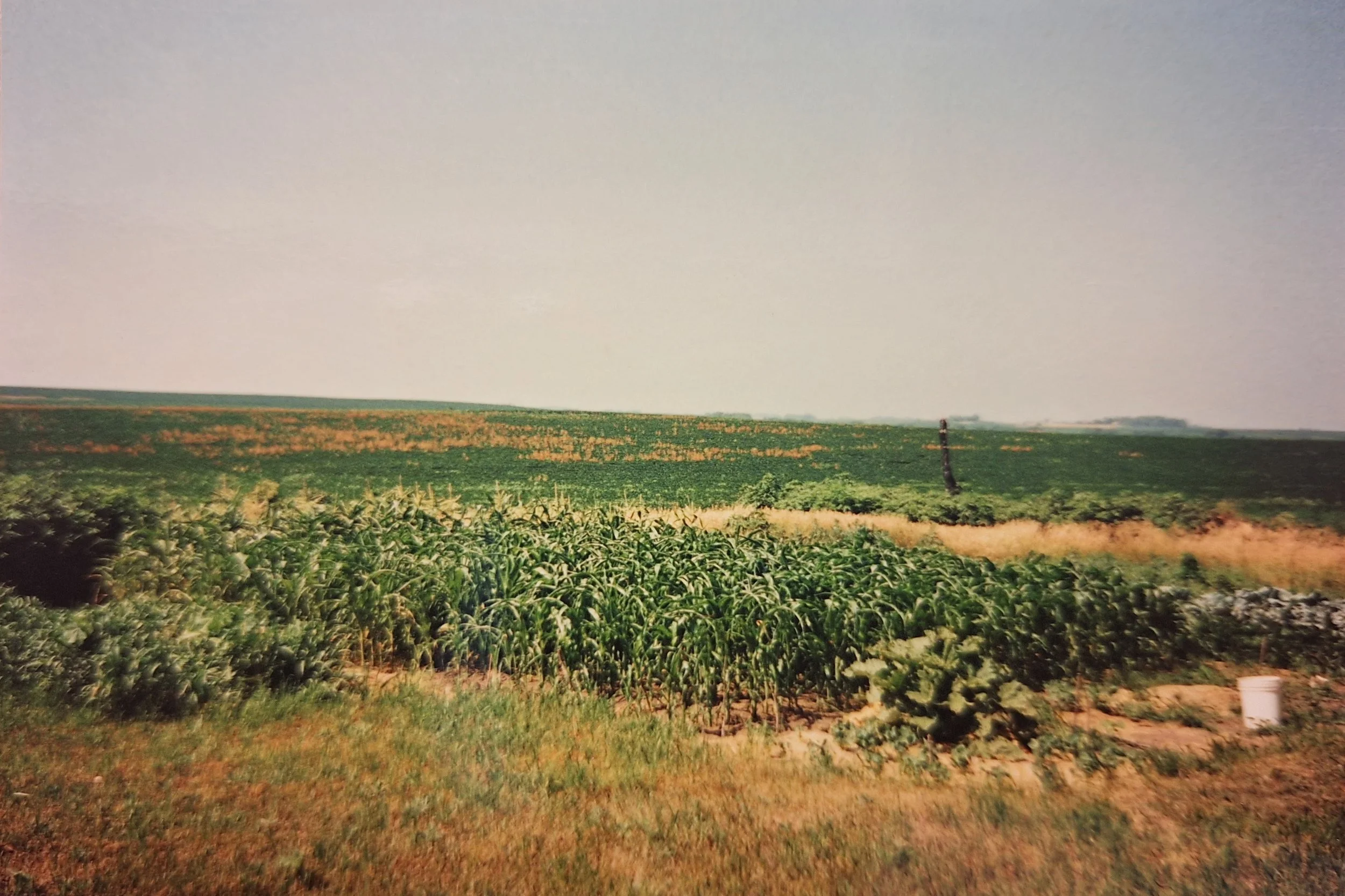
The second year of our lower garden
At the invitation of Ken and Helen, we began to attend the Friends Meeting in West Branch, grateful for the nurture of that community and the peacefulness of silent worship. We joked that Quaker meeting offered the perfect overlap in the Venn diagram of Pat’s Southern Baptist upbringing and my Roman Catholic childhood. Our lives began to slow down, taking on a rhythm wedded to seasonal changes and gentle prairie contours. Pat and I planted our children in this soil and watched them grow, and by the sixth spring of our marriage, a shared life had begun to take a shape and pattern that felt comfortable to us.
Things We Will Miss
Deep into the night
our thumbs split the pods apart
and scoop out the rows
of sweet green peas nestled
in their neat arrangements.
We repeat this act over and
over and talk of our day
as the bowl slowly fills.
This harvest – first fruits
of the sweat and toil we
poured into the garden – is
sweet. Remember
struggling with that beast
of a tiller, turning the earth
on a chill april day as the blue jays
joked among themselves.
Deep into the night
we open these tiny gifts
in order to gather what is
worthy of our dinner table.
The words pour out in long
and short rows. We discard
the cold husks of sentences
as the feeling within comes clear.
The moon slips through the arms
of the maple. Our youngest son
comes downstairs to kiss us
goodnight. And through the years,
shelling peas and talk,
through all the differences and
understandings that shape us,
we settle in with each other.
In the summer of 1987, that sixth summer of our marriage, I was offered an editor position in ACT’s Test Development Department. I would never claim it was my dream job, but I was able to find my people there – Dan, Jim, Janet, Nikki, Caryl, Tom, Christine, Corbin, Cynthia, Ann, Beth, and others. More importantly, my new salary and benefits began to calm the sea of financial troubles that had tested the mettle of our family. Our home in the country, often surrounded by tall cornfields, felt like a refuge where we could finally take a long deep breath.
Footnotes:
[1] While writing this, I was listening to Greg Brown’s music to take me back to that time and place. Born in rural southwestern Iowa in 1949, Brown played regularly at The Mill and the Sanctuary Pub in Iowa City during the 1970s. Over the next four decades, he toured internationally and recorded over thirty albums.
[2] The irony wasn’t lost on us that Reagan’s administration had cut the federal Food Stamp budget while subsidizing the dairy industry by maintaining artificially high milk prices, which encouraged this surplus production.
[3] To bolster our income, I began delivering the Sunday Des Moines Register. At midnight, I’d load up 90 papers from a drop spot in Coralville and, by six in the morning, stuff them in mailboxes all over the eastern half of rural Cedar County.
[4] In 2021, they earned the Iowa Conservation Farmer of the Year Award for their ongoing efforts to protect soil and water quality. Over the years, they’ve employed other innovative farming practices such as planting riparian buffers, contour buffer strips, and most recently, native grass and wildflower pollinator strips.