Braiding Lives
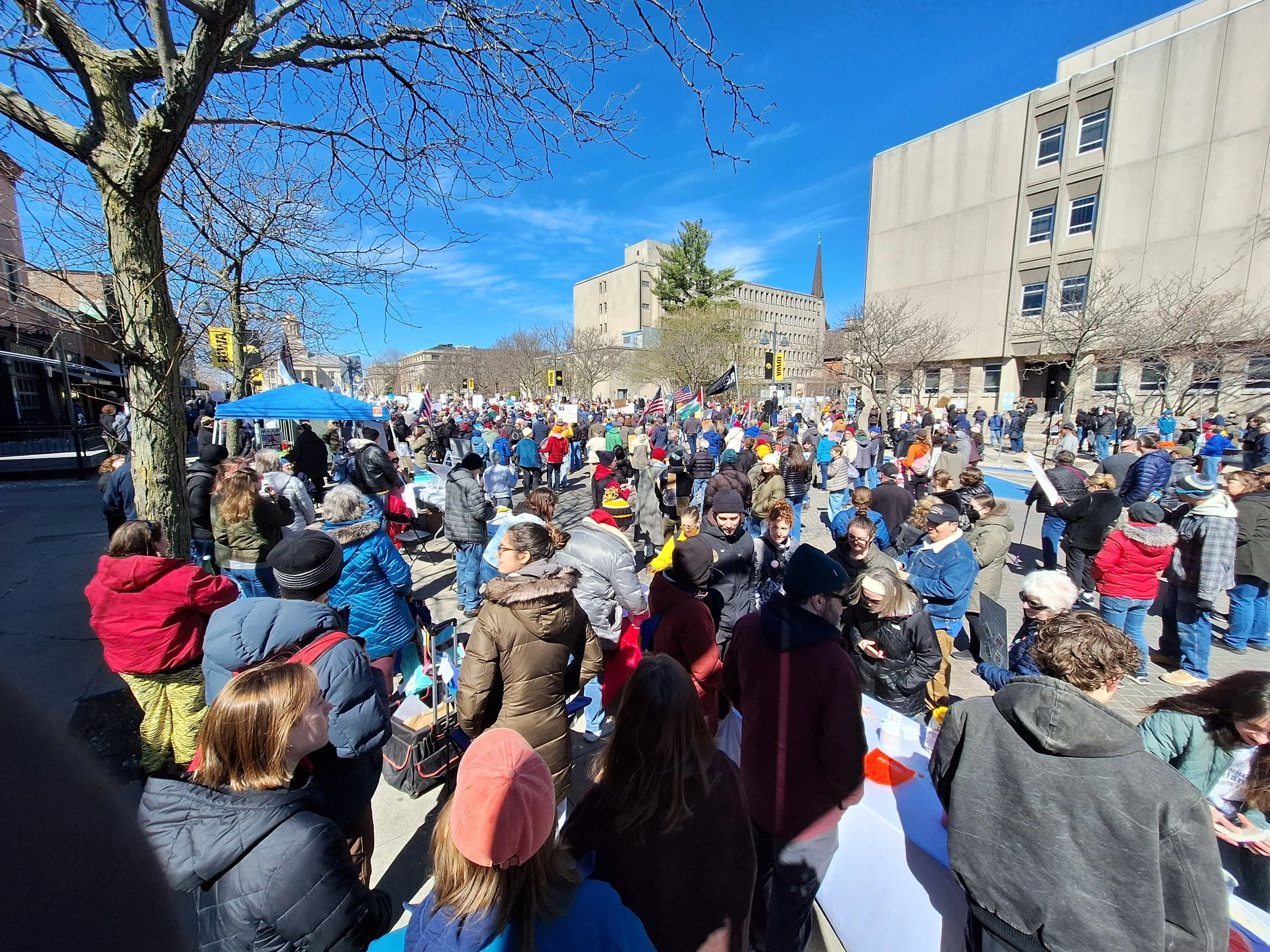
Some of the 2,500+ people at a NO KINGS! Rally in Iowa City (28 March 2026)
I recently discovered the poem “If I Were Another,” by the great Palestinian writer Mahmoud Darwish, [1] which begins:
If I were another on the road, I would not have looked
back, I would have said what one traveler said
to another: Stranger! awaken
the guitar more! Delay our tomorrow so our road
may extend and space may widen for us, and we may get rescued
from our story together.
The poem led me to ponder what it means to engage with that stranger while traveling through life. Chance meetings with others offer the possibility of the interweaving of lives, the braiding of hearts and souls, that can help sustain us in dark times.
+
In February, Cile and I lived in Oaxaca. One Sunday evening, we went to a nearby restaurant to try a popular regional specialty, the tlayuda. It’s a kind of Oaxacan pizza – a supersized tostada heaped with beans, cabbage, tomatoes, avocados, cheese (and meat for those who aren’t vegetarian), and folded once. The restaurant’s little TV was tuned to the Super Bowl, which no one was paying attention to. Until the halftime show, at which point everyone turned to watch the Puerto Rican musician Bad Bunny sing and rap en español. Near the end of his performance, he reminded us that “God bless America!” refers to all twenty countries and territories that comprise America, including Puerto Rico and Mexico. We saw lots of nods of approval around the restaurant. As Cile and I were licking the juices of the sloppy tlayudas from our fingers and sipping our horchatas, Bad Bunny showed us a football with the inscription “Together we are America” and shouted “Seguimos aquí!” – We’re still here! After he spiked the ball, Cile and I turned to the family sitting next to us and exchanged warm smiles with them.
+
On our way back from Mexico, Cile and I had a slight hiccup at the Aeropuerto Internacional de Oaxaca. My carry-on duffel bag was pulled aside after it passed through the X-ray machine, security staff having flagged potential prohibited items. I waited until one of them brought the bag over to me. She asked me to unzip the side pocket containing my toiletries kit and then the kit bag itself. She then pulled out two items – toothpaste and lubricant – that exceeded the 100-milliliter size limit. (The TSA in the Eastern Iowa Airport, by the way, had no problem with those when we flew to Mexico.)
She explained, “Estos están prohibidos,” and began to study them more carefully. Thinking she was trying to identify the products, I said, “Son mi pasta de dientes y lubricante.” And then, because I always hate the idea of throwing anything away, I offered, “Son para tuyo.” Looking at the two of us, she smiled and, pointing at Cile, said, “No, es para ella.”
“Sí, verdad,” I replied, and we all had a good laugh as I tossed the containers in the trash.
+
A few days later, on my way to Cile’s house, I stopped at Jimmy Jack’s Rib Shack to pick up dinner for us. There was a handmade sign by the entrance: “We have shrimp po’boys!” This had never been on their menu before, and I knew Cile would love one, so when I went up to the counter to order, I expressed my delight at this new menu item. Before the young cashier could get halfway through her description of the sandwich and its sauces, I stopped her: “You don’t have to sell me – I definitely want one.” Then I ordered a pork and brisket sandwich for me, and an array of sides. The place wasn’t busy, so we chatted as I finished the order. “I’m liking this look,” she said, drawing a circle with her finger around my face to indicate my forest green fedora and scarf, eyeglass frames with bright green highlights, trim circle beard with more than a touch of gray.[2] “Oh, thanks.” Meanwhile, not finding the cream sodas they usually keep in the cooler behind the counter, I ordered a Modelo Especial for Cile and me to share.
Waiting at a nearby table for my order, I heard the woman talk with one of the cooks via the pass-through window – en español! My ears perked up, and I eavesdropped on their conversation as much as I could. Oaxaca was still on my mind and in my heart, and I was missing the language we’d spent four hours a day studying and conversing in con nuestros maestras y compañeros de clase.
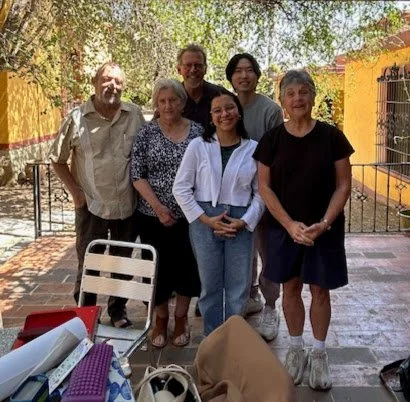
La Maestra Alba y sus estudiantes
As I was heading out the door with my take-out order, two Black women were walking in. We shared friendly smiles and nods, and one of the women gallantly held the door open for me, to which I responded with a bow and a “Thankya, ma’am.”
When I got to the car, I realized I’d forgotten my beer, so I ran back in. The women were placing their order. The cashier who’d waited on me was cleaning the barbecue sauce counter. I caught her eye, made the American Sign Language gesture for “alcoholic drink” – signing the letter Y and tipping it toward my mouth – and said, “Olvide mi cervaza.”
She automatically responded, “Sí, un momento.” As she stepped behind the counter to grab me a beer, I said, “Muchas gracias.” And one of the Black women said, “Hey, the guy speaks pretty good Spanish.” Delighted by this little language connection, I exclaimed on my way out the door, “Acabo de regresar de Oaxaca hace tres días!”[3]
+
A couple weeks later, Cile and I went to a poetry reading at Prairie Lights Bookstore. Ron Villanueva would be reading from his new book, A Holy Dread, joined by two old friends, Kaveh Akbar and Hanif Abdurraquib. As Cile and I chatted, catching up on our days, I noticed a woman our age asking the couple behind us if they could move over so she and her friend could sit together. A little later, I noticed another woman our age on the far side of the room, looking a bit lost. On a hunch, I turned around and asked the woman, “Is that your friend over there?” She turned in the direction I was pointing. “Yes, yes, it is!” And she stood up and waved to draw her friend’s attention.
One of the best features of the reading was the mutual admiration shared by these three men – Hanif had driven all the way from Columbus, Ohio, that day after his flight was cancelled – and during the reading they spoke of the power of their close friendship. Kaveh and Hanif are two of the eighty-five “friends, mentors, and comrades” that Ron acknowledged in his book’s afterword.
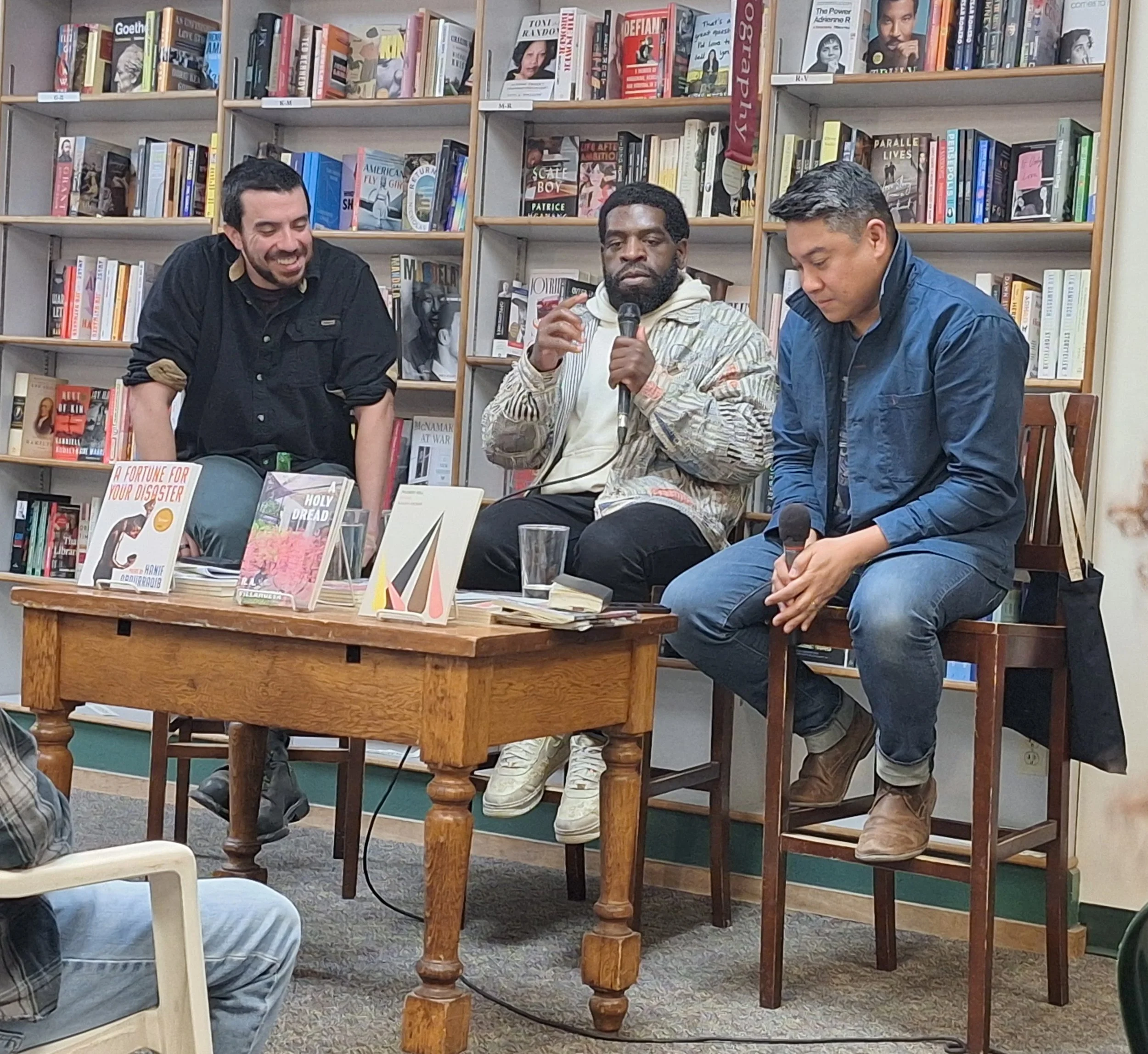
Kaveh, Hanif, and Ron at Prairie Lights Bookstore
Sitting in front of us were three university students, likely a few of the 700-some undergraduates majoring in creative writing at Iowa. Two of the women were friends, but the third, who’d taken the empty aisle seat, struck up a conversation with the other two while waiting for the reading to start. As the event concluded and we were all getting up to leave, the woman in the aisle seat suddenly turned back to the other two: “Wait, let me get your contact info.” And I couldn’t resist gently chiming in with my two cents: “That’s right, y’all – forge those new friendships, just like Ron, Hanif, and Kaveh.”
+
Three mornings a week, my friend Dave and I stop by my local middle school to greet the kids as they come through the front doors. Sometimes we get friendly responses from the kids, sometimes they ignore us, but we feel our presence helps them in mysterious ways. Dave and I both speak Spanish, so when we see kids speaking Spanish or kids with Hispanic features, we’ll often add a “Buenos días!” to our “Good morning!”
Some mornings, it seems as if every kid had stayed on social media or played video games until well past midnight. That Wednesday was not one of those days. Perhaps because of the recent vernal equinox or because the moon was waxing gibbous. Whatever the reason, an unusually large number of kids were particularly perky. Two Latina girls were walking in together; I smiled and said, “Buenos días, chicas!” They glanced over at me and responded, in perfect unison, “Buenos días!” It made my morning.
+
Later that day, I was biking down Iowa Avenue as a young guy was walking out of his house toward his car parked on the street. He was wearing a black suitcoat and slacks and a white shirt, the uniform of a job interview. As I biked past him, I shouted out, “Looking good, brother!” and he called back to me, “Thanks!” His smile made me glad I’d offered that little boost of encouragement.
+
I worked a couple of hours that day sorting donations for a book sale benefiting Shelter House, which serves our unhoused community. Afterward, I went to the University Main Library to meet up with Cile for our weekly writing session. As I walked up to the entrance, a man halfway down the block raised his arms in the air and called out. I couldn’t make out who it was at first, but as he approached, I recognized Adam, a former colleague who left teaching the same year I retired, and is about to wrap up an MFA in the UI Nonfiction Writing Program.
We caught up with each others’ lives there in front of the library. As is true of most good friends, we admire each other. Adam is smart, funny, good-hearted, a great teller of stories. At least part of our friendship is based on the pleasure we take from being smart-alecks. Finally, he said, “Are you hungry?” holding out a wrapped sandwich. “My lunch partner stood me up today, so I have this extra banh mi from Annie’s Vietnamese Sandwiches Shop.” His offer was serendipitous – I hadn’t had lunch yet, and it was 2:30.
As we walked into the library together, three male students were walking out, one carrying a two-foot-long four-by-four. Feeling lighthearted and cheery, I said to him, “Nice wood, man.” The student, Adam, and I exchanged the goofy grin of guys making fun of themselves.
+
Nothing I’ve described in these vignettes is remarkable or monumental. But these human connections have made the strangers who cross my path every day less strange. In the context of this moment in history, when our peace and freedom feel threatened, when we are encouraged to fear others, these interactions feel revolutionary, a kind of resistance. At the very least, they can lift us and fill us with joy as we walk this long road together.
Footnotes
1) Darwish (1941-2008) is widely considered Palestine’s national poet.
2) It’s also known as a Henriquatre, named after a French king.
3) “I just returned from Oaxaca three days ago.”